Solid Surface & Quartz Stone Since 2000 - GELANDY 
Language
Solid Surface & Quartz Stone Since 2000 - GELANDY
A Practical Guide for Wholesalers, Contractors, and Custom Furniture Brands
In recent years, print quartz stone has emerged as a high-end alternative to conventional quartz stone, driven by advancements in digital printing and decorative surface technology. While both belong to the same material system, they serve fundamentally different purposes in the market.
Understanding their differences—and more importantly, how to choose between them—is critical for wholesalers, project contractors, and custom furniture businesses.
1. What’s the Difference?
Print Quartz Stone
Print quartz stone uses digital inkjet printing or decorative layer technology to create highly realistic patterns—often mimicking natural marble or exotic stone. The design layer can be applied on the surface or integrated into the slab.
👉 Key feature: Design-driven material with high visual impact
Conventional Quartz Stone
Conventional quartz stone is manufactured by mixing quartz sand, resin, and pigments, resulting in patterns formed through natural distribution—typically grainy or speckled.
👉 Key feature: Function-driven material with stable performance
2. Core Comparison
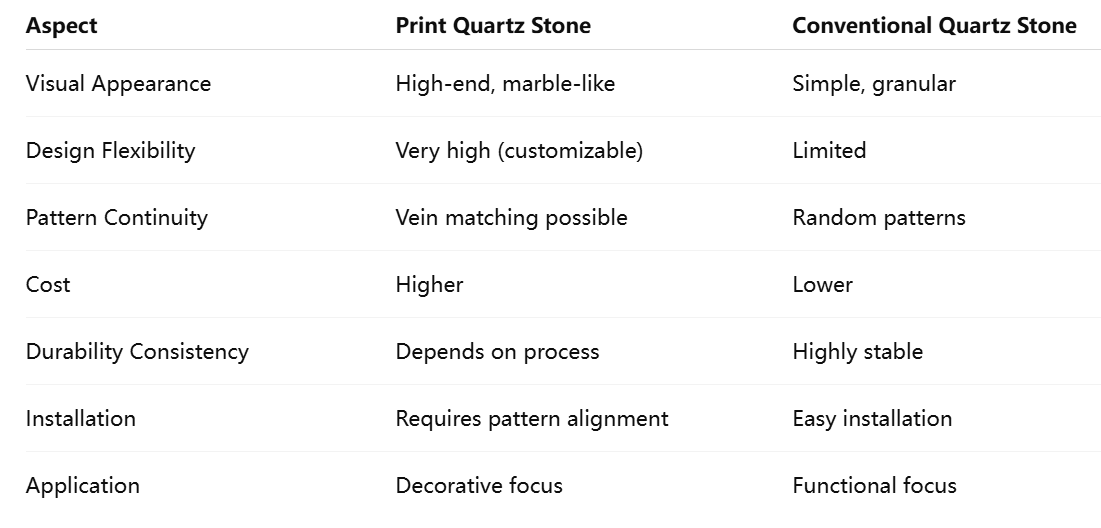
3. Advantages and Limitations
✔ Advantages of Print Quartz Stone
1. Premium Aesthetics
Can replicate natural stone with high realism, suitable for luxury interiors.
2. Design Control
Supports bookmatching, continuous veining, and brand-specific customization.
3. Differentiation
Ideal for brands looking to stand out in a competitive market.
× Limitations of Print Quartz Stone (Critical Insights)
1. Higher Technical Requirements
The bonding between ink layers and quartz substrate is complex. High-quality products require:
Heat-resistant resin systems
UV-stable pigments
👉 Lower-grade products may face color fading over time.
2. Process Sensitivity
Printing often involves heating or secondary curing to enhance ink adhesion.
👉 If poorly controlled:
Thermal stress may develop
Internal structure may be affected
3. Potential Structural Risk (Process-Dependent)
Quartz slabs naturally contain micro-pores. During secondary heat treatment:
Poor density or unstable resin systems may increase risk
Long-term cracking is possible in low-quality products
👉 Important note:
This is not an inherent flaw, but a quality control issue
✔ Advantages of Conventional Quartz Stone
1. Cost-Effective
Ideal for large-scale and price-sensitive projects.
2. Stable Performance
Uniform structure ensures consistent durability.
3. Strong Resistance
Excellent scratch, stain, and impact resistance.
4. Easy Fabrication & Installation
No need for pattern alignment.
× Limitations of Conventional Quartz Stone
Limited visual appeal
Lack of uniqueness in high-end applications
4. Relationship Between the Two
Print quartz stone is not a replacement for conventional quartz stone.
Instead:
Conventional quartz = Performance-oriented material
Print quartz = Design-oriented upgrade
They represent two parallel development paths within the same category.
5. How Different Customers Should Choose
1. Wholesalers
Recommended Strategy: Portfolio Segmentation
Conventional Quartz
Fast-moving products
Price-driven markets
Stable volume sales
Print Quartz
High-margin products
Target designers and premium clients
👉 Key Tip:
Avoid overstocking low-quality print quartz—quality variation is high
2. Project Contractors (Developers / Builders)
Recommended Strategy: Hybrid Solution
Public / High-visibility areas
→ Use print quartz (lobbies, reception, feature walls)
Functional areas
→ Use conventional quartz (kitchens, bathrooms)
👉 This balances:
Cost control
Visual upgrade
3. Custom Furniture & Kitchen Brands
Recommended Strategy: Design-driven Selection
High-end clients
→ Print quartz (islands, vanity tops, statement pieces)
Mass market clients
→ Conventional quartz (kitchen countertops)
👉 Key Value:
Print quartz helps you:
Increase perceived value
Justify higher pricing
6. How to Avoid Common Pitfalls
⚠ When Choosing Print Quartz Stone:
Check Color Stability
Ask for UV resistance test reports
Avoid low-cost products with unclear ink systems
Evaluate Surface Quality
Look for unnatural patterns or pixelation
Check depth of veining (not just surface print)
Understand the Process
Is it surface print or full-body technology?
Is there secondary heat treatment?
Test Structural Integrity
Inspect for micro-cracks
Verify slab density
⚠ When Choosing Conventional Quartz:
Avoid Excessively Low Prices
May indicate low resin quality
Check Hardness & Density
Poor quality slabs chip easily
7. Final Conclusion
Print quartz stone and conventional quartz stone are not competitors—but complementary solutions.
The best choice is not about selecting one over the other,
but about aligning material selection with budget, application, and design intent.
In today’s market:
Conventional quartz remains the foundation of functional applications
Print quartz represents the future of decorative surfaces
“GELANDY " is a senior well-known and excellent manufacturer in China specializing in R & D, production and sales of Solid Surface and Quartz stone.
READ MORE>>

