Solid Surface & Quartz Stone Since 2000 - GELANDY 
Language
Solid Surface & Quartz Stone Since 2000 - GELANDY
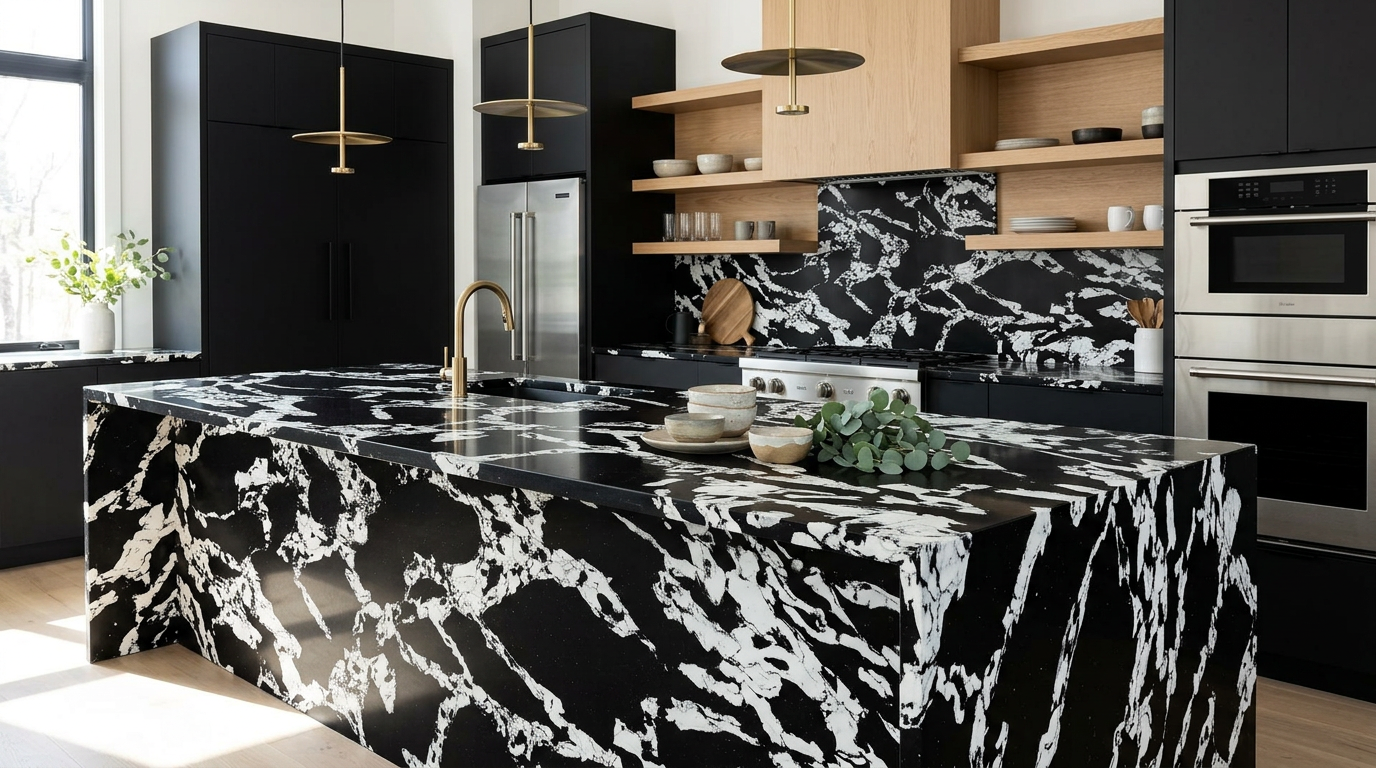
This quartz surface design is a bold expression of contrast—where deep, inky black meets striking, organic white veining in a dramatic visual dialogue. The pattern feels almost like lightning frozen in stone or abstract branches spreading across a night sky, giving it both a natural inspiration and a distinctly modern edge.
What makes this colorway particularly compelling is its sense of movement and energy. The white veins are not subtle accents; they command attention, cutting sharply through the black background and creating a high-impact aesthetic. This “collision” of black and white is not chaotic, but rather controlled and artistic—making it ideal for interiors that aim to be both sophisticated and memorable.
In practical applications, the question often arises: should such a bold surface be used extensively or in moderation?
Large-scale application can be incredibly powerful when done thoughtfully. As seen in kitchen islands, full-height backsplashes, or bathroom feature walls, using this quartz across expansive surfaces creates a cohesive and immersive environment. It turns the material into the focal point of the space, almost like a piece of functional art. When paired with minimalist cabinetry, neutral walls, and clean architectural lines, the dramatic pattern elevates the entire room without overwhelming it.
On the other hand, small-scale application offers a more restrained yet equally refined approach. Incorporating this quartz in areas such as a vanity countertop, a statement island, or even a niche accent allows the pattern to stand out without dominating the space. This is especially effective in interiors where balance and subtlety are key, or where other design elements already play a strong role.
Ultimately, the choice between large-scale and limited use depends on the desired atmosphere. For bold, contemporary spaces that embrace contrast and visual drama, expansive use is highly effective. For more understated or transitional interiors, selective application provides a touch of luxury without excess.
In either case, this black-and-white quartz surface is not just a material—it is a design statement.
“GELANDY " is a senior well-known and excellent manufacturer in China specializing in R & D, production and sales of Solid Surface and Quartz stone.
READ MORE>>

